
Every business that operates physical spaces has a screen management problem, even if it has not been framed that way yet. The menu boards in a restaurant chain that need updating when prices change. The welcome displays in a hotel lobby that should show different content for different events. The safety notices across a manufacturing facility that need to reach every floor simultaneously. The promotional displays in a retail network spread across dozens of locations. These are all versions of the same challenge – getting the right content to the right screen at the right time, reliably and without requiring a person to physically visit each location to make it happen.
Digital signage has been the answer to that challenge for years, but the solutions available to businesses have historically been either too simple to handle real-world complexity or too complex to be managed without dedicated technical staff. Escreen changes that calculation. One platform, all your screens, managed from anywhere.
The Real Cost of Unmanaged Screens
Before examining what a platform like Escreen delivers, it is worth understanding what unmanaged or poorly managed digital signage actually costs a business.
The most obvious cost is operational. A retail chain with fifty locations that manages each screen manually requires someone at each location to update content, troubleshoot technical issues and confirm that displays are showing the correct material. Multiply the time involved across all locations and the labour cost becomes significant – and that cost recurs every time content needs to change.
The less obvious cost is brand inconsistency. When screens are managed locally without central oversight, different locations show different versions of promotional content, outdated pricing, expired campaigns or simply a blank screen that someone forgot to update. In a customer-facing environment, inconsistent digital signage communicates disorganisation in a way that affects brand perception directly.
The least visible cost is missed opportunity. A screen that cannot be updated quickly enough to reflect a flash sale, a supply chain change or a time-sensitive announcement is a screen that is not doing its job as a communication tool. Static signage that takes days to update cannot respond to the pace at which modern business operates.
Central management through a platform like Escreen eliminates all three costs simultaneously.
What Escreen Actually Does
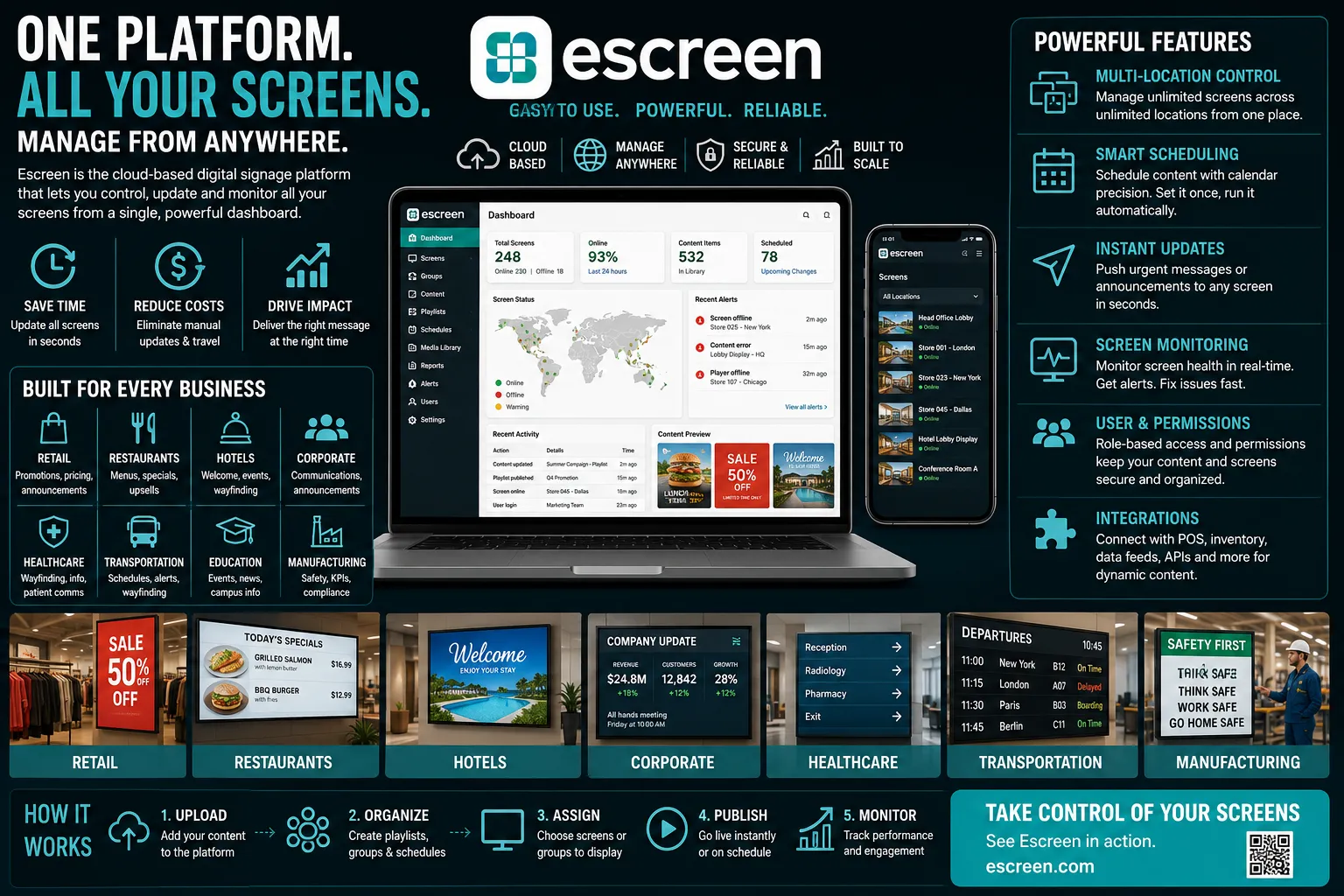
Escreen is a cloud-based digital signage platform that allows businesses to manage content across all their screens from a single interface, regardless of how many screens they operate or where those screens are located.
The core functionality covers everything a business needs to run a professional digital signage operation. Content can be uploaded, organised and scheduled from the platform’s dashboard. Displays are grouped by location, zone, department or any other organisational logic that matches how the business operates. Content updates push to selected screens instantly or according to a predetermined schedule. And the platform provides visibility into what every screen is showing at any given moment.
This sounds straightforward because the execution of it should be straightforward. The complexity that Escreen manages sits beneath the surface – the device management protocols that keep screens connected and responsive, the content delivery infrastructure that ensures updates arrive quickly and reliably, the scheduling engine that handles complex time-based rules across multiple time zones and the monitoring system that alerts operators when a screen goes offline or stops displaying content correctly.
The Businesses That Need This Most
Digital signage management at scale is relevant across a wider range of business contexts than is commonly appreciated. The need is not limited to retail or hospitality – it extends to any organisation that communicates with employees, customers or visitors through screens in physical spaces.
Retail networks are the most obvious use case. A chain of any size faces the challenge of keeping promotional content, pricing information and seasonal messaging consistent and current across all locations. Escreen allows a central marketing team to push content updates to every store simultaneously, schedule campaign changes in advance and confirm that displays are functioning correctly without requiring store managers to become digital signage technicians.
Restaurant and food service businesses deal with the particular challenge of menu boards – displays that need to reflect accurate pricing, available items and promotional offers that change frequently. A central platform that allows menu content to be updated across all locations from one interface, including scheduled changes for breakfast, lunch and dinner menus, eliminates one of the most labour-intensive aspects of restaurant operations.
Hotels and hospitality venues use digital signage for lobby displays, conference room information, event scheduling, directional wayfinding and guest communications. The content across all these touchpoints needs to be coordinated and current. A conference hotel that cannot update its event schedule displays quickly creates confusion for guests and reflects poorly on the operational standard of the venue.
Corporate offices and campuses communicate internally through screens in lobbies, meeting areas, break rooms and corridors. HR announcements, safety information, company performance metrics, event reminders and visitor management information all benefit from a managed digital signage infrastructure that keeps every screen current without requiring individual updates.
Healthcare facilities have some of the most demanding digital signage requirements of any environment. Wayfinding in a large hospital is a genuine functional need. Patient information, appointment flow management and departmental communications all require reliable, accurate and quickly updateable display content. Escreen’s central management capability is particularly valuable in environments where incorrect or outdated information has direct operational consequences.
Transportation and logistics environments use screens for operational information that changes constantly – departure boards, gate assignments, loading dock schedules and safety notices. The ability to push updates instantly from a central platform and confirm that every screen has received and is displaying the correct information is a genuine operational requirement rather than a convenience.
Educational institutions operate screens across campuses that serve multiple audiences simultaneously – prospective students in reception areas, current students in common spaces, staff in administrative areas and visitors in public zones. Managing content appropriate to each audience across all these contexts from a single platform reduces the administrative burden significantly.
The Features That Make the Difference
Understanding what separates Escreen from simpler screen management tools requires looking at the specific features that address real operational challenges.
Multi-location management with granular control means that a business can manage all its screens from one login while maintaining the ability to push different content to different locations, zones or individual screens. A national retail chain can run a national promotional campaign while simultaneously running location-specific offers in certain stores, all scheduled and managed from the same platform.
Content scheduling with calendar precision allows businesses to plan their signage content weeks or months in advance. A campaign that needs to go live at midnight on a specific date, run until a specific time and then automatically revert to standard content does not require anyone to be at a computer at midnight. It is set up in advance and executes automatically.
Real-time content updates allow urgent information to reach every screen in seconds when circumstances require it. A product recall, a safety notice, a sudden price change or an unexpected event can be communicated across all screens immediately without waiting for a scheduled update cycle.
Screen monitoring and health reporting gives operators visibility into the status of every screen in their network. When a screen goes offline, stops displaying content or shows signs of technical issues, the platform generates an alert. This proactive monitoring means that a malfunctioning screen in a remote location is identified and addressed quickly rather than discovered days later by a customer or visitor.
User access and permissions management allows businesses to define who can manage what content on which screens. A regional manager might have authority to update content for their region’s screens without access to other regions. A franchise operator might control their own location’s screens within brand guidelines set centrally. The permissions architecture accommodates the organisational structures of complex businesses without requiring separate accounts or platforms for each level of the hierarchy.
Integration with existing business systems – point-of-sale systems, inventory management platforms, event management software and data feeds – allows Escreen to display dynamic content that updates automatically based on real business data. A restaurant’s menu board that automatically removes sold-out items, a retail display that shows current stock levels or a corporate screen that displays live company metrics from a business intelligence dashboard are all possible through integration.
Content Creation and Management
A digital signage platform is only as useful as the content it can deliver, and Escreen’s approach to content creation addresses one of the most common barriers to effective signage management – the need for design skills and software expertise to create professional-looking content.
The platform includes tools that allow non-designers to create visually effective signage content using templates, pre-built layouts and a content editor that does not require knowledge of graphic design software. Marketing teams can create and update content without routing every change through a design agency or a creative department.
For organisations with existing brand assets and design resources, Escreen accepts content in standard formats that can be produced in any creative tool and uploaded directly to the platform. The content management system handles organisation, version control and scheduling regardless of how the content was produced.
Media libraries within the platform store approved content that can be reused across campaigns and locations. A retail network that needs to reference approved brand imagery consistently across all locations can maintain a central library of approved assets that local managers draw from without risk of brand inconsistency.
The Technical Infrastructure Behind the Platform
The quality of a digital signage platform is largely determined by the reliability of the infrastructure that makes it work. Escreen’s technical architecture addresses the practical challenges that digital signage networks face at scale.
Cloud-based delivery means that the platform and content are hosted on infrastructure that scales automatically with demand. Adding new screens to the network does not require adding server capacity – the cloud infrastructure expands to accommodate growth without operational disruption.
Offline resilience ensures that screens continue displaying content even when the internet connection at a location is temporarily interrupted. Content is cached locally on display devices so that a network outage does not result in blank screens. When the connection is restored, the device automatically syncs with the platform to receive any updates that occurred during the outage.
Compatibility with existing hardware reduces the capital investment required to deploy Escreen across a business that already has screens in place. The platform is compatible with a wide range of commercial display hardware and media players rather than requiring the purchase of proprietary Escreen hardware.
Security and access control protects the platform and the content it manages. User authentication, encrypted data transmission and audit logs of all content changes ensure that the platform meets the security requirements of organisations with formal IT governance processes.
With escreen.io you get a digital signage platform built for the operational realities of businesses managing screens across multiple locations. The platform combines the content management tools, scheduling capabilities, monitoring features and integration options that turn a collection of individual screens into a coordinated communications network.
Return on Investment – How to Think About the Numbers
Digital signage platforms are an operational investment and the return on that investment comes from several directions that are worth quantifying for the business case.
Labour cost reduction is the most direct calculation. If central management through Escreen reduces the time spent on signage management at each location by two hours per week across a twenty-location network, that represents forty hours of labour per week redirected to higher-value activities. The annual value of that labour saving can be calculated against the platform cost to produce a straightforward return on investment figure.
Campaign execution accuracy reduces the cost of errors. A promotional campaign that reaches all locations simultaneously, on schedule and with the correct content eliminates the cost of partial campaign execution, customer complaints about inconsistent pricing and the operational disruption of fixing errors after the fact.
Reduced print and static signage costs represent a direct comparison in many businesses. Print production, shipping and installation costs for physical signage changes can be significant at scale. Digital signage that can be updated centrally without any physical production replaces those costs over time.
Revenue impact of better content is harder to measure but real. Promotional content that reaches customers at the right time, in the right format and with accurate information converts more effectively than static or outdated signage. Menu boards that reflect current availability and pricing reduce order errors and customer dissatisfaction.
Implementation – What to Expect
Understanding the implementation process reduces the uncertainty that often delays digital signage investment decisions.
The initial setup involves connecting your display hardware to the Escreen platform, organising your screen network within the platform’s management interface and configuring user access for everyone who will manage content. For organisations with existing screens and technical resources, this is typically a straightforward process that can be completed in days rather than weeks.
Content migration involves uploading your existing signage content to the platform, organising it within the content library and setting up any recurring schedules or rules that reflect your current content strategy. The platform’s content management tools are designed to make this process efficient without requiring technical expertise.
Training for content managers focuses on the platform’s dashboard and content scheduling tools. Escreen’s interface is designed to be usable by marketing and communications staff without technical training, which means the learning curve is short and the platform reaches productive use quickly.
Ongoing management after implementation is where the platform’s value compounds. As the team becomes familiar with the scheduling tools, content library and monitoring features, the efficiency gains from central management increase over time.
Frequently Asked Questions
The platform scales to manage networks of any size, from a handful of screens to thousands across multiple locations.
Escreen is compatible with a wide range of commercial display hardware – verify compatibility with your specific hardware during the evaluation process.
Yes, the permissions system allows granular access control so users manage only the screens and content relevant to their role.
Content is cached locally on display devices so screens continue showing content during internet outages and sync automatically when connectivity is restored.
Updates push to connected screens in seconds after publication from the platform dashboard.
Escreen serves businesses at different scales – check the platform’s pricing and plan options for the specifics relevant to your network size.
The Screens Are Already There
Most businesses that need Escreen already have the screens. They have invested in displays, installed them in customer-facing and internal spaces and are using them at a fraction of their potential because the management infrastructure to operate them effectively is not in place.
The gap between a screen that shows the same static image it showed three months ago and a screen that shows precisely the right content for the current moment, updated automatically from a central platform, is not a hardware gap. It is a software and management gap. Escreen closes that gap.
The platform exists. The infrastructure is ready. The screens you already own are waiting to be managed properly.